
Nvidia Benefits Page
By Will Hammond, CFP®, CFA and Matthew Lewis, CFP®, CFA
Updated September 30, 2026
As an Nvidia employee, you have many issues to consider in the management of your equity compensation, tax exposure, retirement planning and career development. By taking a holistic view across all aspects of your wealth, we create a plan designed for your particular circumstances.
Aligning your Nvidia Stock Unit (NSU) plan, tax deferred accounts, investment strategies and risk management policies, we create a whole greater than the sum of its parts so that you reach your goals with confidence and ahead of schedule.
Already holding a large NVDA position? See our guide to diversifying Nvidia RSUs without a tax disaster.
Compensation Basics for Nvidia Employees
Nvidia compensates its employees through salary, restricted stock units and cash bonuses. In the absence of tax planning, all three are taxed at ordinary income tax rates.
Restricted Stock Units
Nvidia provides its employees with stock awards by way of restricted stock units (NSUs), which come in three forms:
Initial NSU grant
Annual stock refresher
Out-of-cycle bonus
Initial RSU Grants
Initial RSU grants are generally determined as part of the hiring process. NVIDIA has used several vesting schedules over time, and employees should refer to their individual grant documents for the terms applicable to their awards. NVIDIA’s current standard employee NSU grants generally vest over four years on a front-loaded 40%/30%/20%/10% schedule, with vesting occurring quarterly.
For example, suppose a new NVIDIA employee receives an on-hire RSU award with a target value of $250,000. If the share price used to determine the award were $200, the employee would receive 1,250 RSUs. Under a 40%/30%/20%/10% vesting schedule, 500 shares would vest during the first year, in four quarterly installments of 125 shares each. During the second year, 375 shares would vest, or approximately 94 shares per quarter; during the third year, 250 shares would vest, or approximately 63 shares per quarter; and during the fourth year, the remaining 125 shares would vest, or approximately 31 shares per quarter. Actual quarterly share amounts may vary slightly because of rounding.
NVIDIA’s current standard employee NSU grants generally vest over four years on a front-loaded 40%/30%/20%/10% schedule, with vesting occurring quarterly.
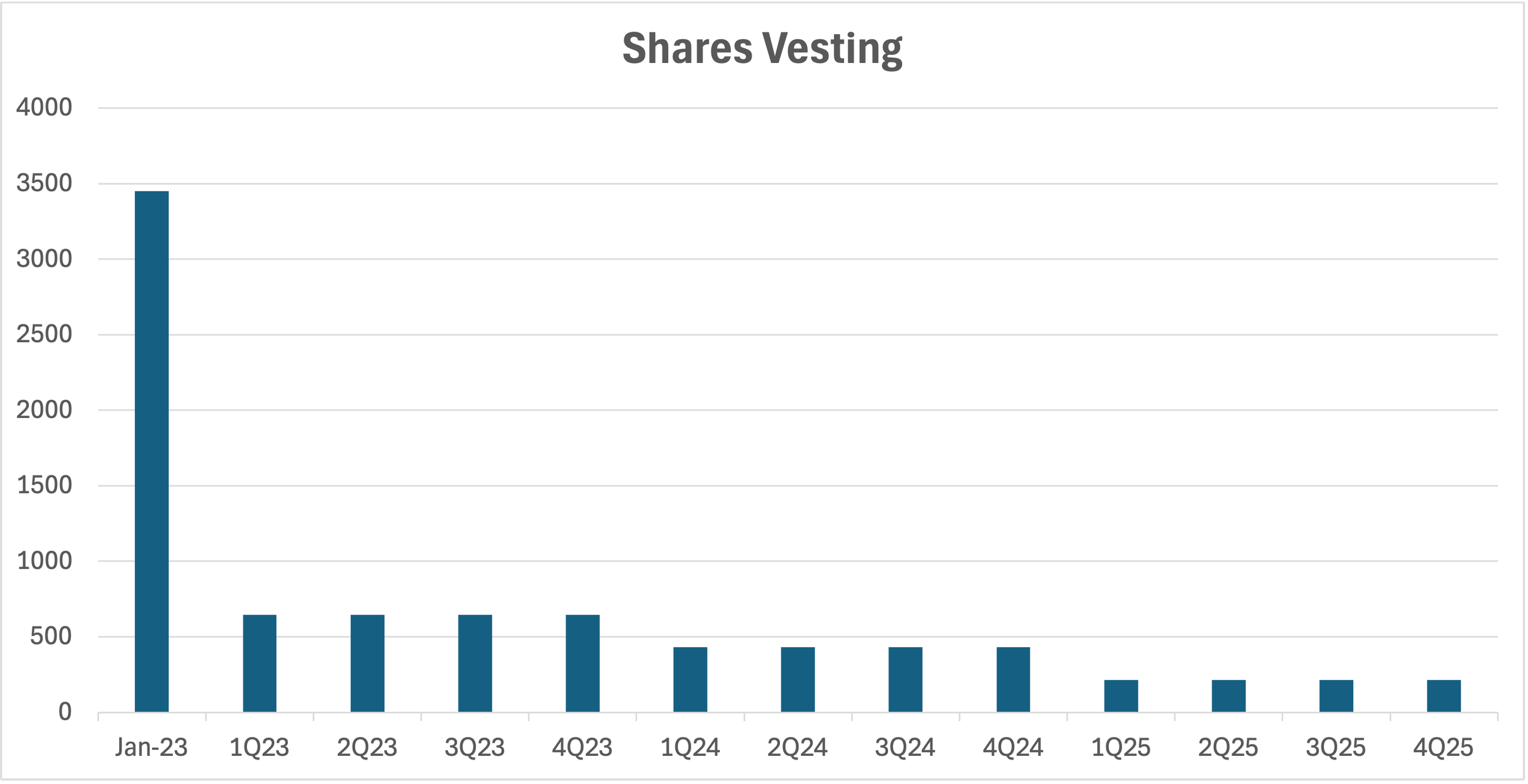
While vested amounts are front-loaded, stock-price acceleration can smooth the value received. For example, here’s how the dollar value of the Nvidia RSU grant described above would have played out:
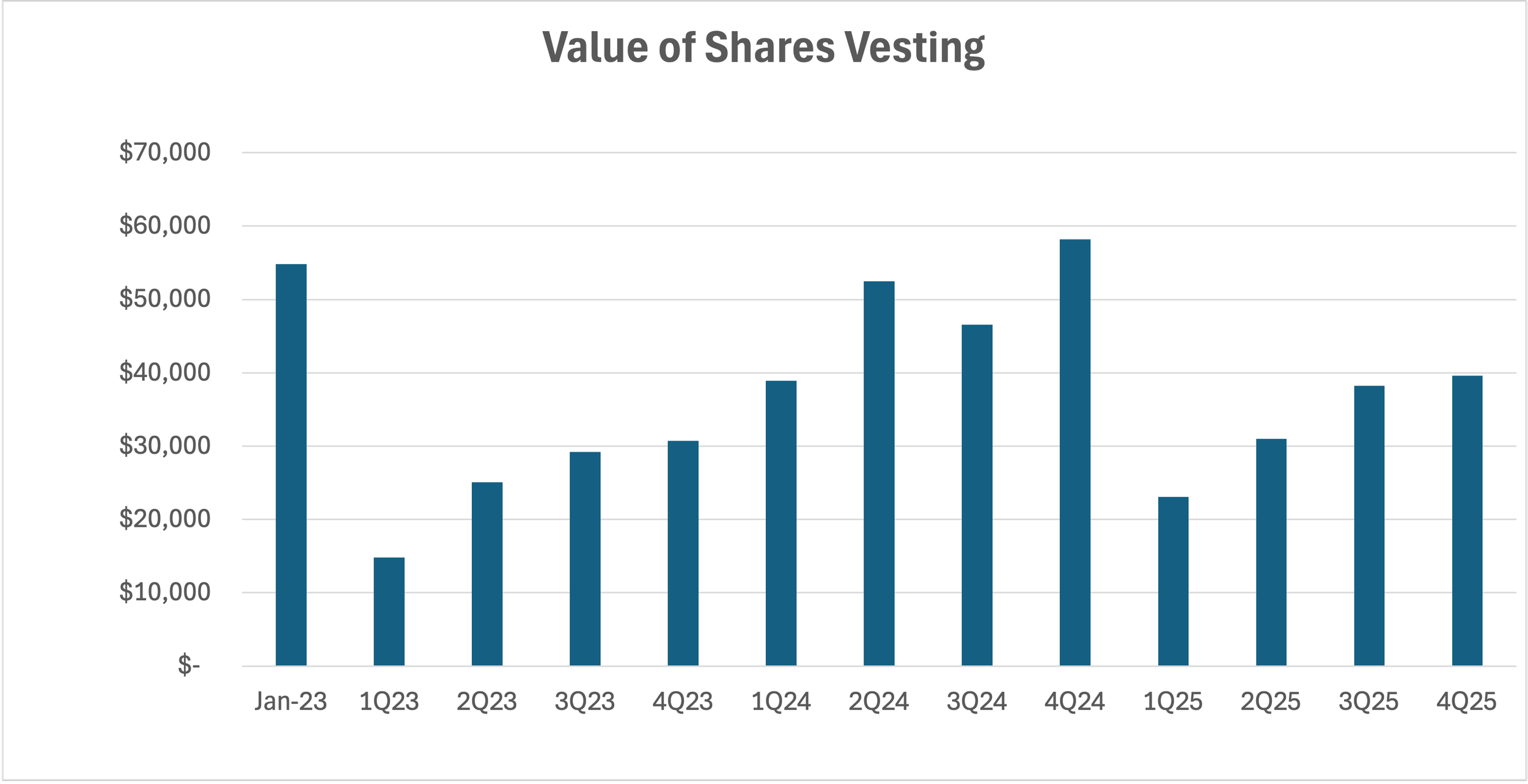
Stock Refreshers
Annual restricted stock unit refreshers are typically issued starting an employee’s second calendar year for high performance. The units vest quarterly over 4 years.
Performance Stock Units
Nvidia grants Performance Stock Units (PSUs), that vest based on performance metrics, not time with the company (as is the case with RSUs). These goals include company financial performance, stock performance, or strategic objectives, and usually 1 to 3 years. Depending on how well the objectives are met, 0-200% of target shares are awarded.
Tax Withholding on RSUs
When your RSUs and PSUs vest, Nvidia keeps some of the vested shares and uses them to pay your payroll taxes (Social Security and Medicare) and to withhold federal and state income tax. Federal income tax is withheld at a flat 22% on up to $1 million of supplemental wages in a year, and at 37% above that. California employees also typically have 10.23% withheld for state income tax, plus 1.3% for State Disability Insurance. For many Nvidia employees in the 32%, 35%, or 37% brackets, 22% falls short, and the difference comes due when you file your return.
A shortfall can also trigger an IRS underpayment penalty, but that's avoidable. You won't owe a penalty if your withholding and estimated payments cover at least 90% of this year's tax, or 100% of last year's (110% if your prior-year AGI was over $150,000). You can close the gap by making quarterly estimated payments, or by raising your paycheck withholding through a new W-4. Withholding counts as if it were paid evenly through the year, even when you increase it late in the year.
If your RSUs have accumulated into a large NVDA position, the next question is how to reduce it without an avoidable tax bill. Our guide to Nvidia RSUs covers which shares cost the least to sell, what Nvidia's trading policy allows, and how to put it on a schedule.
Nvidia 401(k)
Whether your retirement is quickly approaching or over the distant horizon, our job is to help you make the most of the resources available to you as an Nvidia employee, including a thoughtful combination of pre-tax and after-tax savings for your circumstances.
1. Nvidia’s Contribution Match
Nvidia’s matching contribution uses a two-tiered structure:
Tier 1: 100% match on your first $6,000 contributed → $6,000
Tier 2: 50% match on your next $11,000 contributed → $5,500
Maxing Out the Match: By contributing $17,000 (pre-tax or Roth), you secure the full $11,500 in employer matching funds. All matched funds vest immediately.
2. Contribution tiers & company match
| Age | Your contributions | Nvidia match | Total per year |
|---|---|---|---|
| Under 50 | $24,500 | $11,500 | $36,000 |
| 50–59, or 64 and olderStandard catch-up | $32,500$24,500 + $8,000 | $11,500 | $44,000 |
| 60–63Super catch-up | $35,750$24,500 + $11,250 | $11,500 | $47,250 |
- Totals exclude after-tax (mega backdoor Roth) contributions, which can add up to $36,000 more.
3. High-Earner Catch-Up Rule (SECURE 2.0)
If your prior-year FICA compensation exceeded $150,000:
Any catch-up contributions in your elective deferral (the amounts above $24,500) must be made as Roth (after-tax) contributions.
Nvidia does not match catch-up contributions beyond the standard $17,000 match threshold.
Nvidia Mega Backdoor Roth
The Nvidia 401(k) offers a Mega Backdoor Roth, which allows after-tax contributions to be converted to a Roth. This conversion forever more shields investment earnings from income tax. In other words, qualified distributions from the account become entirely tax-free (both contributions and investment earnings).
Unlike a Roth IRA, which is capped at $7,500 in annual contributions in 2026 ($8,600 for those 50 years and over), a Mega Backdoor Roth allows for much more substantial contributions in the tens of thousands of dollars. At Nvidia you can contribute up to an additional $36,000 in aftertax dollars to your 401k which you can later convert into a Roth.
Self Directed Brokerage Account
Nvidia gives employees the option of setting up a self directed 401(k) accounts known as BrokerageLink through Fidelity NetBenefits. The account offers a broad investment universe, including a variety of ETFs and individual stocks.
Should you choose to become a client of TechView Wealth Advisors, you can elect to have us manage your self-directed account in order to benefit from our expertise in investment management and tax planning.
How we help Nvidia Employees with their 401(k):
Advise you on the allocation of pre-tax and post-tax retirement savings to your 401(k) over traditional pretax, Roth and Mega Backdoor Roth contributions.
Guide you in planning and executing a Mega Backdoor Roth.
Review your savings each quarter to help you receive the full company match
Monitor investment performance and implement investment, savings, and tax-minimization strategies tailored to your long-term goals
Assist you in setting up and managing a self-directed brokerage account within your 401(k).
Establish a mix of passive and active investment strategies tailored to your particular requirements.
Apply our valuation approach to leading technology stocks in the management of your portfolio.
Make use of risk management strategies with mechanical rules that minimize human emotion and error.
Employee Stock Purchase Plan
Employee stock purchase plans offer an opportunity to purchase company shares with after-tax dollars at a discount. At Nvidia, that discount is 15% off the lower of the offering price (the closing price on the first trading day after the month you enroll) or the closing price on the last trading day of that purchase period. The employee stock purchase plan remains in effect for 2 years, and is split into 4 purchasing periods. Best of all, an employee’s offering price remains the same for the entire 2 years!
*For example, a new employee starting work in December 2021 and immediately opting into the plan would have received an offering price of $30.06/share (the closing price on January 3, 2022.). At the end of the first offering period, the stock price was ~$14.50, so the employee would have received his shares at a 15% discount to $14.50, or $12.33/share.
While the employee stock purchase plan does increase single-stock concentration risk in your overall portfolio, this risk can be managed allowing you to reap the discount (i.e. free money) benefit. With the right plan in place, this benefit is generally worth evaluating with an advisor.
We cover how to manage that concentration risk in our guide to Nvidia RSUs.
*Hypothetical example for illustration only, based on Nvidia's actual historical stock prices during that period; past price movements do not predict future results.
How we assist with retirement planning:
Help you invest in a tax-efficient manner based on your circumstances.
Advise you on the allocation of pre-tax and post-tax retirement savings to your 401(k) over traditional pretax, Roth and Mega Backdoor Roth contributions.
Guide you in planning and executing a Mega Backdoor Roth.
Assist in setting up and managing a 401(k) self-directed brokerage account.
Establish the appropriate mix of passive and active investment strategies tailored to your particular situation and goals
Provide you a customized client portal where you can monitor all your assets, liabilities, and financial plan.
If you would like assistance navigating the complexities of Nvidia’s employee benefits, schedule an introductory call with us.
Disclaimer
TechView Wealth Advisors is not endorsed by or affiliated with Nvidia. The information on Nvidia’s employee benefits plan is provided for educational purposes only. While we strive to provide insightful and up-to-date information on Nvidia employee benefits, TechView Wealth Advisors does not guarantee its accuracy.