Microsoft Benefits Resource Page
As a Microsoft employee, you have many avenues for building wealth, including stock incentives, retirement accounts, employee stock purchase program and possibly deferred compensation. All of these strategies have short and long-term tax and single-stock risk consequences that, if not managed properly will yield a suboptimal outcome. By taking a holistic view across all aspects of your wealth, we create optimal solutions for you and your family.
Aligning your RSU plan, tax deferred accounts, investment strategies and risk management policies, we create a whole greater than the sum of its parts so that you reach your goals with confidence and ahead of schedule.
Compensation for Microsoft Employees
Microsoft compensates its employees through salary, RSUs and cash bonuses. In the absence of tax planning, all three are taxed at ordinary income tax rates.
Restricted Stock Units
Microsoft attracts and secures top talent with restricted stock units (RSUs), which come in three forms:
An on-hire RSU grant
Annual stock awards
Special Stock Awards and Leadership Stock Awards
On-Hire RSU Grants
On-hire RSU grants are negotiated during the hiring process, and typically vest annually over 4 years, beginning on the start-date anniversary. The total number of shares in the on-hire restricted stock grant is computed by dividing the total dollar value of the grant by the closing price of Microsoft on the employee’s start date.
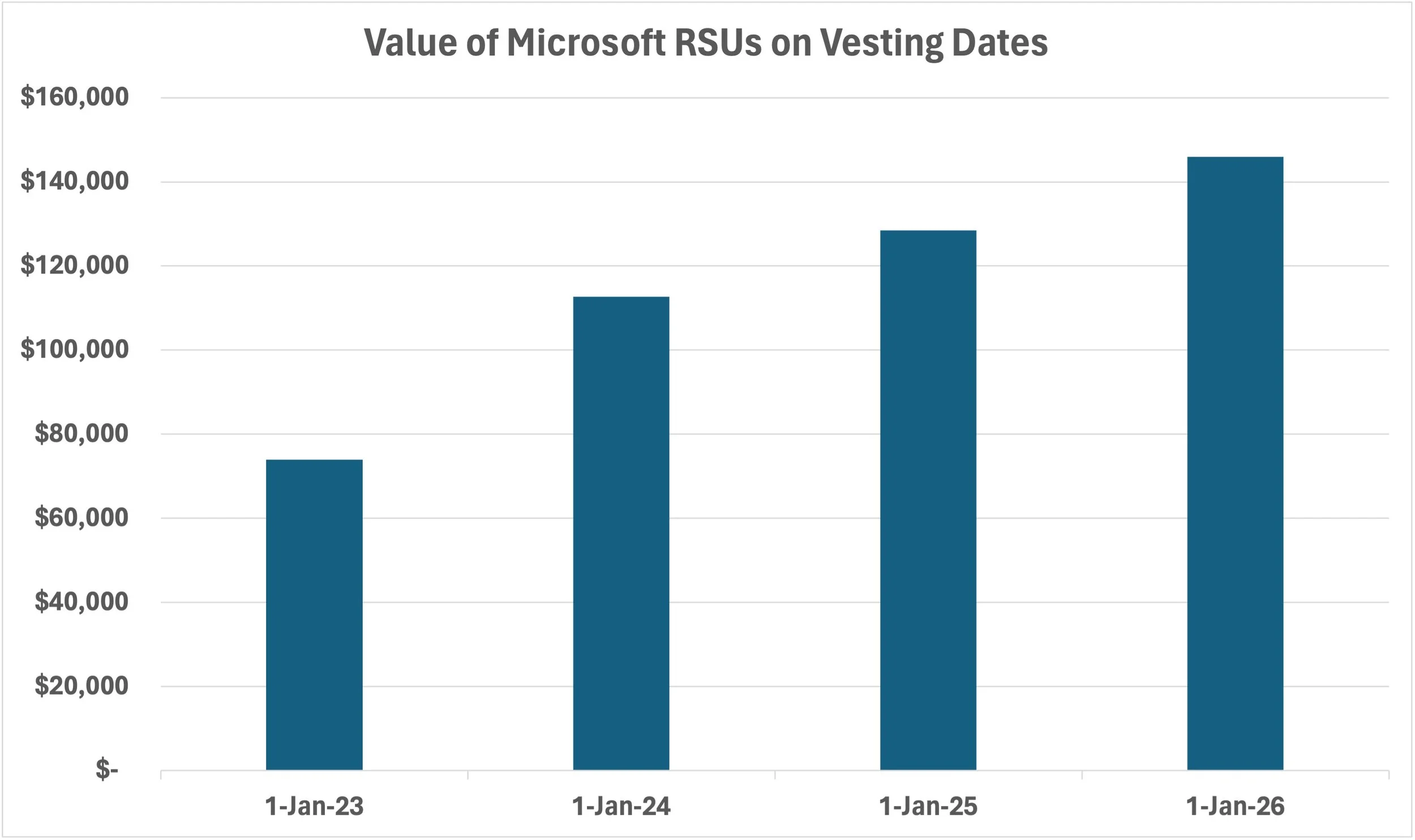
For example, a new employee starting work on January 3, 2022 with an on-hire restricted stock unit grant of $400,000 would get $400,000/$323.90, or 1,235 RSUs. For the next four years on the anniversary of his start date, he would get roughly 309 RSUs.
Ideally, Microsoft’s stock price will rise over the vesting period, so that the dollar value of the shares received rises over time (even though the number of shares does not change). Here’s how a $400,000 RSU grant made at the beginning of 2022 would have vested in dollar terms over the following 4 years:
Annual Stock Awards
As part of Microsoft’s annual review and compensation evaluation process in August, employees are eligible for stock awards. Shares vest evenly over a 5-year period and are paid quarterly. The number of shares awarded is computed by dividing the award amount by the closing price of Microsoft on the last business day of August.
Special Stock Awards & Leadership Stock Awards
These out-of-cycle bonuses are less predictable and are usually issued to exceptionally high-value employees who Microsoft considers targets for poaching by competitors.
Taxation of RSUs
RSUs are taxed as ordinary income upon vesting and as a capital gain or loss upon the sale of the shares received. To learn about RSU tax mistakes and how to avoid them, watch our video on RSU taxation.
Tax Withholding on RSUs
When RSUs vest, Microsoft sells a portion of the resulting shares to cover payroll taxes (social security, medicare, etc.) as well as state and federal income tax. For those making less than $1 million dollars in annual supplemental wages, the withholding rate is typically 22% of the market value of the shares. However, this is often not sufficient to cover the employee’s tax liability to the IRS, resulting in penalties in addition to the unpaid tax.

Microsoft’s 401(k)
Whether your retirement is quickly approaching or over the distant horizon, our job is to ensure that you marshal all the resources available to you as an employee of Microsoft. Working with us, you can rest assured that you are making the optimal combination of both pre-tax and after-tax savings for your circumstances.
Microsoft’s Contribution Match
Microsoft matches 50% of every pre-tax or Roth employee dollar contribution up to the Federal elective deferral limit ($24,500 in 2026). In absolute terms, this amounts to $12,250 in “free money” from Microsoft, with all contributions vesting immediately. Employees 50 and older can contribute another $8,000 in pre-tax dollars beyond these limits to their 401(k), and employees 60-63 can contribute another $11,250 in pre-tax dollars beyond the limits above. However Microsoft does not match these catch-up contributions.
Microsoft Mega Backdoor Roth
The Microsoft 401(k) offers a Mega Backdoor Roth, which allows after-tax contributions to be converted to a Roth. This conversion forever more shields investment earnings from income tax. In other words, qualified distributions from the account become entirely tax-free (both contributions and investment earnings).
Unlike a Roth IRA, which is capped at $7,500 in annual contributions in 2026 ($8,600 for those 50 years and over), a Mega Backdoor Roth allows for much more substantial contributions in the tens of thousands of dollars. At Microsoft you can contribute up to an additional $35,250 in aftertax dollars to your 401k which you can later convert into a Roth.
Self Directed Brokerage Account
Microsoft gives employees the option of setting up a self directed 401(k) accounts known as BrokerageLink through Fidelity NetBenefits. The account offers a broad investment universe, including a variety of ETFs and individual stocks.
Should you choose to become a client of TechView Wealth Advisors, you can elect to have us manage your self-directed account in order to benefit from our expertise in investment management and tax planning.
How we help Microsoft Professionals with their 401(k):
Advise you how to allocate your pre-tax and post-tax retirement savings to your traditional and Roth 401(k) accounts.
Guide you in planning and executing a Mega Backdoor Roth.
Optimize your savings each quarter ensuring you receive the full company match.
Monitor investment performance and implement investment, savings, and tax-minimization strategies tailored to your long-term goals.
Assist you in setting up and managing a self-directed brokerage account within your 401(k).
Establish a mix of passive and active investment strategies tailored to your specific requirements.
Use our proprietary valuation models of leading technology stocks to manage your portfolio.
Employ of risk management strategies with mechanical rules that minimize human emotion and error.

Employee Stock Purchase Plan
Employee stock purchase plans offer an opportunity to purchase company shares with after-tax dollars at a discount to market value. At Microsoft, that discount is 10% to market value. Employees can have up to 15% of each paycheck, up to a maximum IRS annual limit of $25,000, allocated to the plan. Offerings take place over a 3-month window in which the elected percentage of compensation is withdrawn from each paycheck. The discounted price received equals 90% of Microsoft’s closing price on the last business day of the offering period.
While the employee stock purchase plan does increase single-stock concentration risk in your overall portfolio, this risk can be managed allowing you to reap the 10% discount (ie free money) benefit. With the right plan in place, we highly recommend exercising this benefit.
Deferred Compensation Plan
Microsoft provides a Deferred Compensation Plan (DCP) to management and/or highly compensated employees (at stock level 67 or higher). Participating in Microsoft’s DCP potentially offers three types of tax benefits:
Lower current taxes by deferring salary and cash bonuses.
Tax-deferred growth.
Potential increase in future year taxes can be lessened by spreading distributions over time.
Other important aspects of a Deferred Compensation Plan
Enrollment period for salary deferment.
Enrollment period for bonus deferment.
Constraints on when one must decide the timing of distributions.
Investments available through the DCP.
Company-based risks - DCP obligations are unsecured and participants have the same level of claim on assets as general creditors.
Individual based risks.
How we assist with retirement planning
Ensure that you invest in the most tax-efficient manner possible.
Advise you on the allocation of pre-tax and post-tax retirement savings to your 401(k) over traditional pretax, Roth and Mega Backdoor Roth contributions.
Guide you in planning and executing a Mega Backdoor Roth.
Assist in setting up and managing a 401(k) self-directed brokerage account.
Establish the appropriate mix of passive and active investment strategies tailored to your particular situation and goals
Provide a customized client portal where you can monitor all your assets, liabilities, and financial plan.
If you would like assistance navigating Microsoft's retirement plan and would like to tailor your investment decisions to your financial goals, schedule an introductory call with us.